Families welcoming newborns look forward to joyful milestones and sleepless nights, but for some parents, the earliest days bring uncertainty and a search for answers. In 2006, Lee Reavey and his wife sensed there was something different about their youngest son after birth. The family was referred to Great Ormond Street Hospital (GOSH) after they exhausted testing options at their local hospital.
.jpg?mw=300)
Months later during an intensive round of testing, two geneticists by chance recognized features that matched a rare syndrome. Reavey’s son was diagnosed with Nicolaides-Baraitser Syndrome (NCBRS), a rare genetic condition Reavey’s son was the 7th known case at that time globally.
With no roadmap and almost no research available on NCBRS, Lee and his wife set out to start a small support group for families. At their first meeting, six families from across Europe gathered to hear from the geneticists at GOSH who spotted Reavey’s son years before.
As diagnoses slowly increased, the need for broader support for NCBRS patients and caregivers became clear. “We decided to expand our charity worldwide,” Lee says. What began as a UK group grew into the NCBRS Worldwide Foundation, a global charity supporting families, building community, and advocating for more research. Today, the foundation is made up of families and professionals from all over the world.
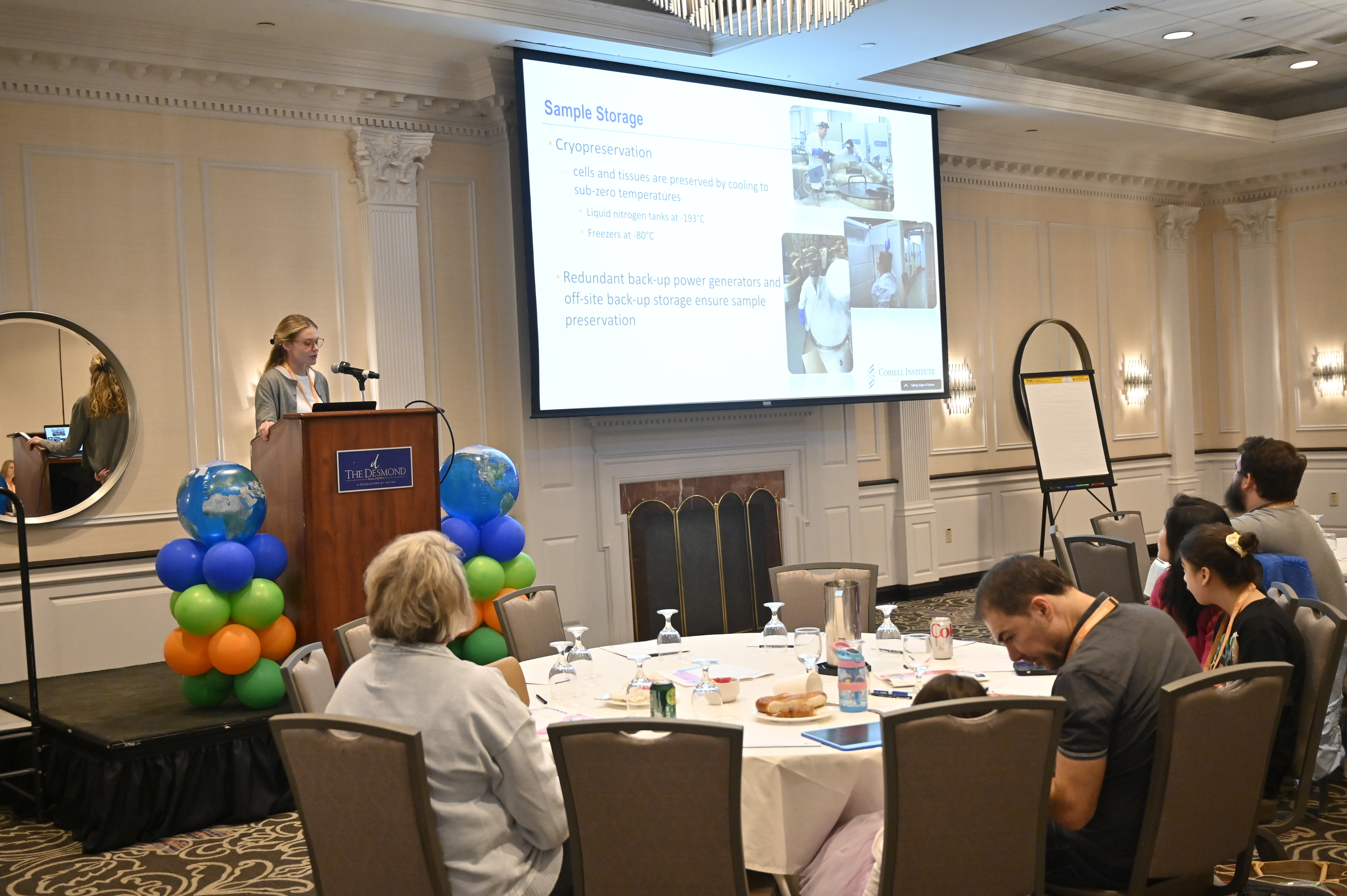
As global membership increased, NCBRS Worldwide Foundation set out to host a hybrid conference based in the US. Thanks to volunteer parent and advocate Nicole Radio, the event in Malvern, PA went off without a hitch, hosting Dr. Paola Nicolaides who first described the syndrome in 1993, Dr. Dustin Paul of Penn State and Dr Jacqueline Harris of Kennedy Krieger Institute, as well as representatives from the Coriell Institute for Medical Research.
Sophia Gross, a Project Manager here at Coriell, spoke at the conference in Malvern about the importance of biobanking as a source of support for rare disease research, as well as how NCBRS families could donate samples to the NIGMS Human Genetic Cell Repository, a program of the Coriell Institute for Medical Research. Coriell also organized sample collections with 14 families at the conference. Though the repository holds more than 11,900 cell lines and 6,200 DNA samples; there had previously been no representation of NCBRS in its catalog.
Since the founding of the NIGMS Human Genetic Cell Repository in 1972 at Coriell, this biobank has been home to some of the world's most important cell lines, representing a variety of disease states, chromosomal abnormalities, and many distinct human populations. Coriell is also home to four year and IH-funded biobanks, distributes thousands of samples every year, and offers world-class research and biobanking services to scientists around the globe.
To learn more about our biobank collections, visit coriell.org/1/Browse/Biobanks.